How do you find a nomadic village?
Our sampling strategy made it possible for very small, and sometimes mobile villages to be chosen. One of theses was Anoujjab. It was supposedly about 25 km south of the town of Ingal. I was very excited about seeing Ingal, because it is the site of the Cure Salee, and huge gathering of nomadic pastoralists who bring their livesstock to the area at the height of the rains when the desert is covered with water, which is very salty due to the high mineral content of the water. The cattle are brought to drink this water, which acts as an anti-parasitic. It's also an important social and cultural event. We were too late by three weeks - the water was gone and the nomads dispersed. Oh well. Anoujjab was not on the map in the health center, but one of the older men knew of a nomadic group often in the area called Ajjab, and we thought this was probably the same group. We brought him with us as a guide, and stopped at the market, where we found out that this group had migrated to an area north of Ingal, and they told our guide approximately where, so we set off across the desert in search of our "village". On the horizon, you can sort of make out the mirage, which I learned that day is especially compelling in the desert - it really does look like a lake in the distance!
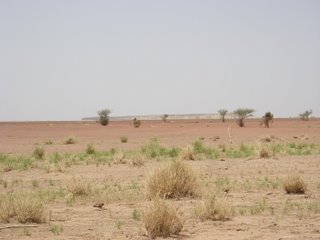
On the way, we ran across several nomadic families on the move. This is a small family with their donkeys, but coming up on a large group traveling with numerous camels was amazing.
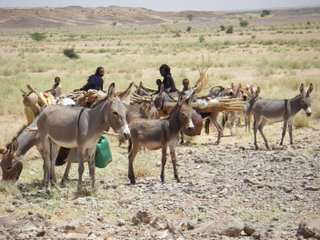
One thing that cannot be said of men in Niger is that they don't stop for directions. The way you find a village, or find out whether your team has passed through that village, is to stop and ask the group of men under the nearest tree, or on the nearest camel, or with the nearest flock - we were constantly stopping and asking directions.
Our guide (in the lighter blue) was great about jumping out of the vehicle and inquiring the whereabouts of Ajjab. On this day, everyone seemed to know this group - they were always just a little further.
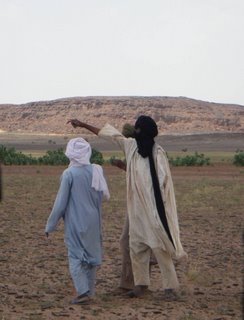
They went that a'way!
Stay tuned...
 In this picture, I'm drinking fresh cow milk out of a calabash. Yes, I am a public health official. :)
 Finally, pictoral proof that I was on a camel. Wore pants this time! :) Still made a horrible noise.
 Guinea fowl are semi-domesticated in Niger, and sometimes must breed with chickens. You run into an occasional bird with the head of a guinea fowl and the plumage of a chicken. They're very funny looking. The meat is delicious and better than chicken. The little village chickens are sometimes called "poulet bicyclette" - pretty self explanatory even in English - well describes how scrawny they are!
 All the lambs were napping in one of Tateye's tents - these are just 4 of 20 or so in the tent.
 Lambs are the world's sweetest, most docile creatures, and quite cuddly. Lamb hardly sounds like a name for God after holding one. It starts sounding so blase to western ears, and you don't realize after hearing it so often how shocking it was in its original context. Also had a lot of time for meditations on sheep....one, they are pretty dumb animals, always crossing the road at the wrong time, they usually do run around mixed in with the goats (although I would separate them by the fact that sheep are the ones with the floppy ears and tail), and they're also pretty docile and trusting, after watching them be tossed up on top of a minivan and strapped down.
 Feeding a baby camel - they can make the same horrible sounds as the adults, but all babies have this cuteness...


 Here's a shot of me in front of a camel, with a bunch of gorgeous kiddoes. I learned, although I don't have pictoral proof, that you can't ride a camel side saddle. I was in a skirt and couldn't get my leg over the other side of the saddle. Camels do not get up or down evenly. When they sit down, first the front legs fold half way, then the back legs fold all the way, and the front legs fold all the way, tilting crazily, and they are usually making the most horrendous half roaring half moaning sound. Quite a process!
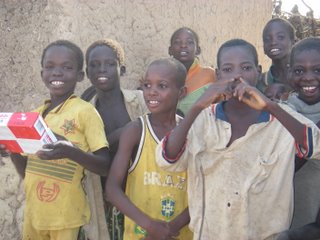
 The children in Fagochia were spectacularly beautiful. While the others were mapping, they took me to the chief's wife's tent, where somehow about 20+kids crowded in around me in a tent not more than 12 feet across.
 I used the opportunity to take pictures and passed the camera around so they could see their pictures. I also learned my first Tamashek (Tuareg language) word - tanimert - which means thank you.
 I passed my camera to one of the Tuareg women and showed her how to take a picture. Got a couple decent shots, too! The necklace I'm wearing is Tuareg made - bought in Agadez.
 There were mosquito nets hung in many of the tents. I love this shot of the kids playing underneath the mosquito net!
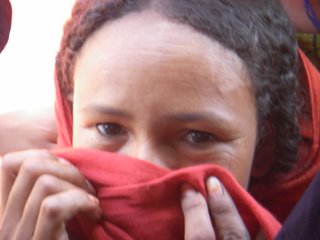 One of my favorite pictures - I'm not sure why this woman was covering the lower portion of her face as the others were not, but her eyes tell a thousand stories.
 One of our surveyors administering the questionaire in the tent, with the guys looking on.
 With the chief's wife - she is wearing one of the ornately embroidered outfits in the Agadez market picture, as well as the real indigo head scarf. Guess I needed my head covered, too. I thought she looked so elegant.


 They went that a'way!

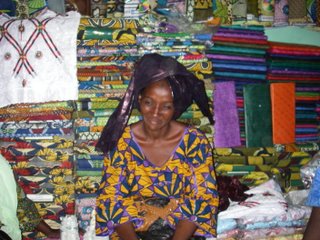
 One of our team members buying food in the market. There are huge basins of all sorts of herbs, spices, grains, vegetables, and fruits grown in nearby oases.


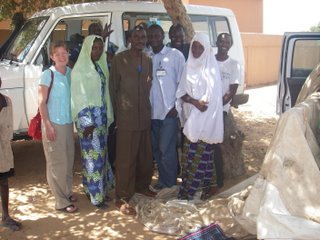
 Stopping for a coke and a yogurt with the team
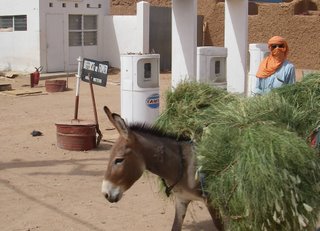
 Donkeys still don't get out of carrying grass, though I'm not sure where they found that much grass near Agadez!
 In the end, this didn't really matter. In the domain of TMI, Niger it's a place where it's possible to drink 2 liters of water in the morning and still not pee until 10 pm that night. I probably spent most of my time pretty dehydrated, but it was more convenient.
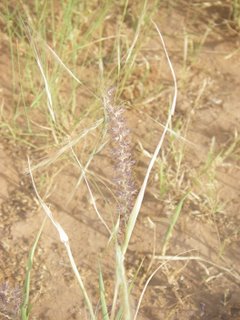 When you did get out to walk around, the little grass was often covered with these incredibly painful, tenacious little burrs that you then had to spend the next half hour removing.


 Sunset - so many were just gorgeous. And during Ramadan, much looked forward to. Ramadan started in the middle of the survey, and made already grueling work (house to house mapping all day in the sun) much harder. Our teams got up at 5 am to eat and drink, and then didn't eat or drink until sunset. Some of the especially religious ones, don't even swallow their own saliva, something that was particularly annoying in our driver. Every 5 minutes, the vehicle would slow down, he'd roll down the window, and spit. Anyway, everyone knew exactly what time sunset was every night, and we'd stop right then so they could have a drink (we'd often spend the previous hour procuring ice and drinks) and a snack, and then prayer. Dinner was much later. In most Muslim countries, more food is bought and consumed during Ramadan than during other months!
 Here is Moussa breaking his fast with dates. Moussa Malam Barke was easily my favorite supervisor - absolutely brilliant, very hard working, very upbeat, and total problem solver. He was just terrific and I enjoyed working with him.
 A woman in the village preparing millet - removing it from the stalks with her bare hands in the hot sun. After that, she will separate the grains from the chaff, and then pound it. Talk about a woman's work being never done!


 I thought this little girl was just gorgeous - took me a while to get her picture.


 A wadi with a little water still standing in it. Even when they're dry, there's water just under the surface and people dig down to it. We drive across plenty of them, but I'd hate to get caught in one when it fills!


 Here are a few cattle grazing in front of the huge onion shaped granaries - they aren't huts, but places to store millet, and in most villages they far outnumber huts. The design is fascinating as the walls are quite thin, but they're fairly sturdy. The straw cap on top hides the hole that millet is dumped into (and I assume, withdrawn from).
 During the rainy season, water collects in numerous small depressions everywhere, and these areas are key watering areas for livestock and surprisingly rich in wild life, especially birds (and mosquitoes). These dry up midway through dry season, forcing migrations for water.
 There are a few larger lakes that remain through out the year, and this one is beside the village of Sehia. No matter how big or small the water collections are, the muddy water is always full of kids!
 There are surprisingly huge herds of cattle, and livestock are incredibly important to each family. The boys are responsible for herding them, and I saw the boys and their herds amazingly far from villages.
 Cows are used not only for the meat and hides (Nigeriens do incredibly gorgeous leather work - I came home with a gorgeous leather rug and matching pillows), but also for pulling the ubiquitous carts.
 Donkeys are actually the backbone of transportation - and these donkeys are tiny compared to American donkeys. When ridden, it's usually by children, though adults can ride if they seat themselves over the donkeys hindquarters but sometimes their feet drag. They pull and carry incredibly huge loads - sometimes you almost can't see the donkeys under their loads. These are pulling food aid (grain sacks) across a road over a wadi. One of my team said that donkeys go straight to heaven because they suffer so much on earth.
 Children riding a donkey. I imagine Mary and Joseph had a donkey fairly similar to this one. Made it easier to picture the trip to Bethlehem, with a pregnant girl on a tiny donkey.